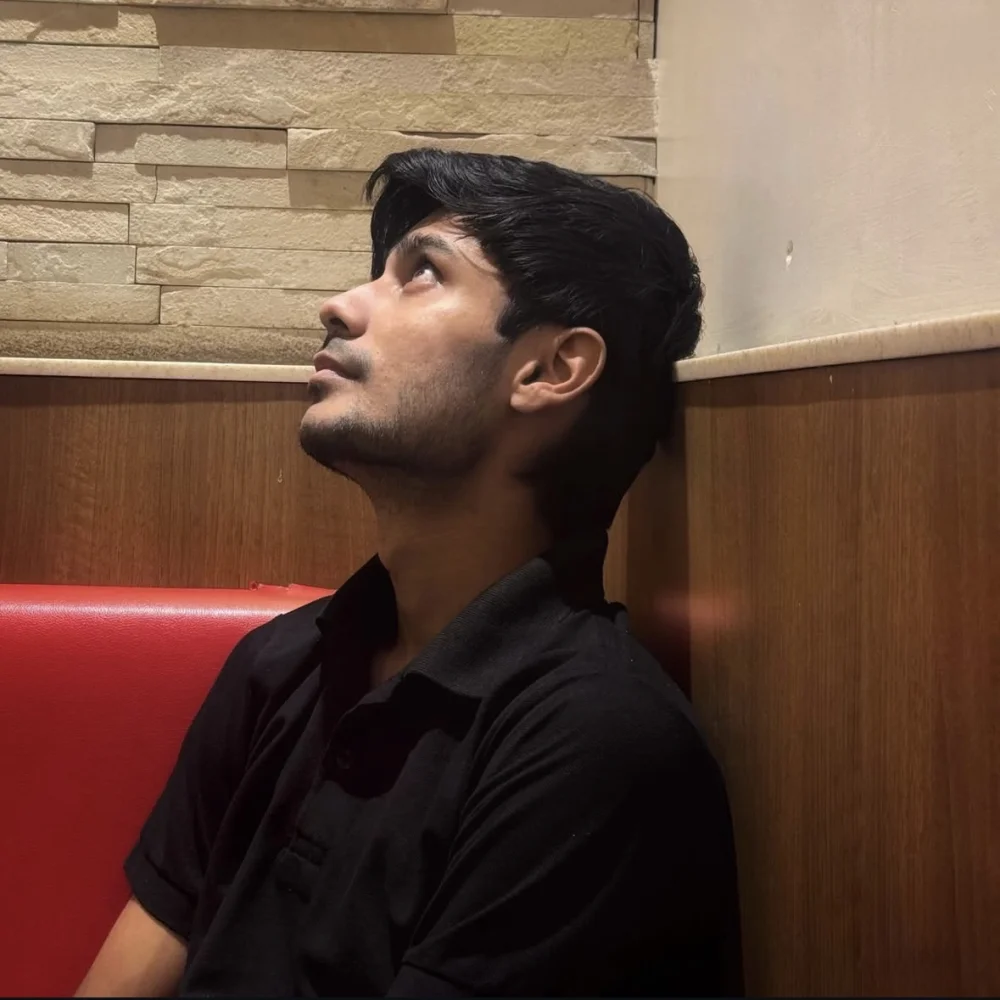
Piyush Chaudhary
Piyush Chaudhary is the founder of Docdril. Starting with video production and a personal creative channel, his work gradually grew to include web development, workflow automation, and digital products. Today, he leads Docdril with a focus on combining reliable creative craft with practical technology to help modern businesses operate with clarity and momentum.
“I wanted to know what I was capable of, so I stopped relying on assumptions and started finding out.”
The Unexplored Question
After finishing college, Piyush was genuinely unsure about whether he could earn independently and handle the responsibilities of a professional working environment. He had spent his earlier years exploring different interests, hobbies, places, and ideas. He was optimistic about his goals, but having never completed an internship or worked in a conventional setting, professional and financial independence were still unexplored territories.
His first job was not a carefully planned career-growth strategy; it was an experiment in understanding himself. He wanted to test whether he could maintain discipline, handle long hours, show up consistently, and take full responsibility for professional work—discovering what he was capable of doing rather than assuming he was ready.
The Value of the Test
He spent approximately six months in that role, primarily editing videos for modest pay. The experience served its purpose. It confirmed his day-to-day consistency and taught him the direct relationship between time, effort, and creative output. He saw firsthand how long creative tasks actually take, where production workflows break down, why operational efficiency matters, and how his contribution should be valued.
Once he had answered those early questions about his stamina and working capacity, his priorities shifted toward better opportunities, fair compensation, and long-term growth. When he decided to leave, the departure was contentious and he did not receive the employment documentation he had expected. Rather than dwelling on the dispute, the experience clarified his direction: it reinforced his need for independence and confirmed that his future should be built on his own terms, with direct ownership over his work.
From a Creative Outlet to Docdril
Docdril originally began during his daily commute. Thinking about the video projects he was creating, he wanted a dedicated outlet to publish and showcase his work under an identity of his own. He chose the name Docdril. At the time, it was not planned as a large creative-tech studio—it was simply a personal creative space that was entirely his.
After leaving his job, he began treating Docdril as a serious independent venture. The expansion into technology happened gradually: while creating and editing visual content, he became increasingly curious about what sits behind the finished output—the websites that present it, the operational tools that support it, the workflows that keep production moving, and the technology that makes new possibilities accessible.
That curiosity led him to study modern web development, build practical automations, and develop custom digital products. Along the way, exploring early interface concepts and UI/UX design experiments helped bridge the gap between creative visual work and software engineering. Rather than treating creative production, engineering, and automation as isolated disciplines, Docdril evolved into a studio that brings them together to help modern businesses operate with clarity and momentum.